
Welcome back to The Melody of Life, where parenting meets creativity, music, and joy.
If you’ve ever found yourself Googling “how to be a better parent” while reheating your coffee for the third time, you’re not alone. Parenting doesn’t come with a step-by-step guide—but it does come with moments. Little ones. Big ones. Messy ones. Not every moment is going to be easy, and we’re going to make mistakes more times than we’d like. When the inevitable happens and we lose our patience, or snap at our kids, or scream in frustration, how do we come back from that? How do we use those moments as an opportunity to grow and heal our relationship with our kids?
One word—connection.
Famous relationship researcher, John Gottman, found that there is a “magic ratio” of 5:1 – for every one negative interaction, there should be at least five positive interactions. Usually, this has been used in the context of romantic relationships, but it also applies to every kind of healthy relationship, including parent/child. By connecting with your child, you are building up your “bank” of positive interactions, which will then help to reduce tantrums and improve their ability to follow directions.
In this post, I’ll share some fun and simple musical strategies you can use to foster a healthy relationship with your child.
It’s Not About Getting It All Right
There’s so much pressure today to be a perfect parent—craft the perfect lunch, plan the perfect activity, manage the perfect screen time. But here’s something I’ve learned (and continue to learn every day): our kids don’t need perfection.
They need presence.
They need to be seen, heard, and loved. And sometimes, the best way to offer that is through simple, shared moments—like a silly sing-along in the kitchen or a dance party in the living room.
Those small, seemingly ordinary things? They’re the heartbeat of connection.

Music as a Bridge
Music has this beautiful way of bringing people together. It helps us express what words sometimes can’t. For kids, it’s not just fun—it’s grounding. Rhythms, melodies, and lyrics give them a sense of structure, safety, and joy. And for us parents? Music can become one of our most powerful tools for connection.
Here are some ways to use music to deepen your bond with your child:
1. Make Mornings Musical
Start the day with a wake-up song. It doesn’t have to be fancy—just something consistent and cheerful. A few gentle notes sung while pulling back the curtains or brushing hair can create a warm morning rhythm and help ease transitions (which we know can be tough with little ones).
2. Create a Family Soundtrack
Sit down together and build a playlist of songs your family loves. Include songs from your childhood, their favorites from cartoons, silly dance tunes, and calming tracks for bedtime. Play it during car rides or chore time and notice how it shifts the mood.
Let your child help pick the songs—it gives them a sense of agency and makes it a shared experience.
3. Sing Instead of Saying “No” (Sometimes!)
When you’re stuck in the “no” cycle—no jumping on the couch, no cookies before dinner—try turning your message into a playful song. Something like:
🎵 “Cookies come after carrots, that’s our dinnertime deal!”
It may not always work, but often a little humor and rhythm can diffuse tension and get a giggle.
4. Use Music to Support Routines
Songs can help guide daily transitions. A special song for brushing teeth, getting dressed, or cleaning up turns mundane tasks into something familiar and fun. You can make up your own together, or if you would like some fun transition song ideas already ready to go, download my free printable PDF of five of my favorites!
5. Have a Dance Break
When the day starts to unravel (you know the moment), call for a spontaneous dance break. Blast a favorite tune and let loose in the kitchen or living room. It’s an instant mood shifter—and it reminds your child (and yourself) that joy can live right in the middle of the chaos.
6. Sing to Calm Big Emotions
Music can be incredibly soothing during meltdowns. Try humming or quietly singing a lullaby or calming tune while holding or sitting near your child. Your voice becomes a grounding presence, helping them regulate without needing many words.
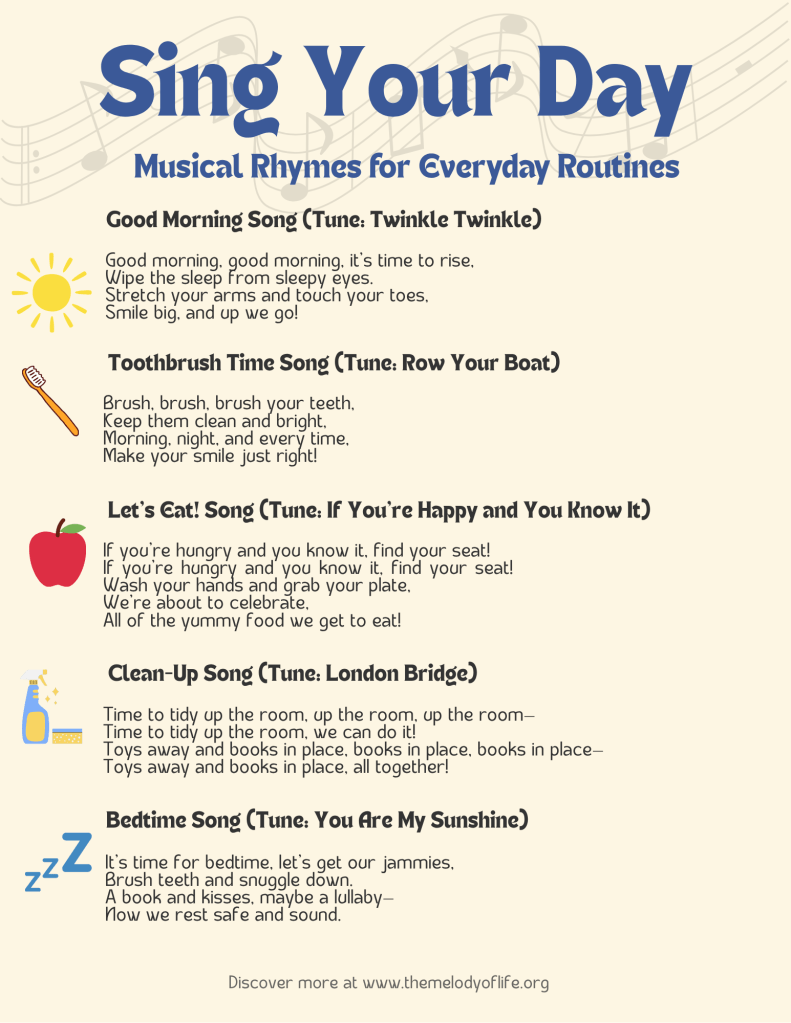
Download the high resolution PDF of this image using the link above.
Let Go of the “Right Way”
You don’t need to be a musician. You don’t need perfect pitch. You don’t even need to remember all the lyrics. Your child isn’t listening for a flawless performance—they’re listening for you.
Connection is the goal. Not the song itself.
So sing off-key. Make up silly lyrics. Let your child bang a pot while you play air guitar. Let go of doing it “right,” and focus on doing it together.

You’re Doing Better Than You Think
If no one’s told you lately: you’re doing a beautiful job. Showing up, even when it’s hard. Trying, even when you’re tired. Laughing through the chaos. That’s what parenting is all about.
Let’s keep making memories. Let’s keep learning from our kids. Let’s keep turning the everyday into something a little more musical.
Have you found any of these ideas helpful? I’d love to hear what’s been helping you deepen your connections with your kids. Drop a comment below or connect with me on Facebook [The Melody of Life] or Instagram [@the_melody_of_life_mt].
Click here to read how music impacts your child’s brain and simple ways to bring more music into your everyday routines.
Until next time! May your life’s melody lead you toward peace and love.
Want more real-life parenting tips, along with other free monthly activities and coloring page printables? Subscribe to the newsletter (it’s free!).
About the Author

Julie Perley is the author of The Melody of Life and is a board-certified music therapist, wife, and mom to three wonderful children. Her goal is to provide informative, fun, and supportive resources for any parent, educator, or caregiver of children. Read more about the author here.

 The Melody of Life
Leave a comment